
Rice University scientists and their collaborators recently made a groundbreaking discovery that adds a new layer of significance to The Beach Boys’ iconic hit single “Good Vibrations.” They identified a method to eliminate cancer cells by leveraging the ability of certain molecules to vibrate strongly when exposed to light.
The team observed that the atoms in a small dye molecule, commonly used in medical imaging, can synchronize vibrations, forming a plasmon, when stimulated by near-infrared light. This synchronized vibration leads to the rupture of the cell membrane in cancerous cells. The results, detailed in a Nature Chemistry publication, showcased a remarkable 99% efficiency in eradicating lab cultures of human melanoma cells. Additionally, half of the mice with melanoma tumors achieved a cancer-free status after undergoing this treatment.
Describing this innovative approach as a “whole new generation of molecular machines” named molecular jackhammers, Rice chemist James Tour explained that his lab had previously utilized nanoscale compounds featuring a light-activated chain of atoms, similar to a paddle, which spins continuously in one direction to penetrate the outer membrane of infectious bacteria, cancer cells, and treatment-resistant fungi.
In contrast to nanoscale drills based on Nobel laureate Bernard Feringa’s molecular motors, molecular jackhammers utilize an entirely distinct and unprecedented mechanism of action. Tour emphasized their remarkable speed, being over a million times faster in mechanical motion than the previous Feringa-type motors, and their activation with near-infrared light instead of visible light.
Near-infrared light, with its ability to penetrate up to 10 centimeters into the human body, surpassing the limited half-centimeter depth of visible light, represents a significant breakthrough, as explained by Tour, Rice’s T. T. and W. F. Chao Professor of Chemistry and a professor of materials science and nanoengineering. This advancement enables access to organs and bones without causing damage to surrounding tissues.
The molecular jackhammers at the core of this innovation are aminocyanine molecules, belonging to a class of synthetic fluorescent dyes commonly used in medical imaging. According to lead author Ciceron Ayala-Orozco, these molecules, known for their biocompatibility, stability in water, and affinity for cell membranes, had been used in imaging without knowledge of their plasmonic activation potential.
Having studied plasmons during his doctoral research with Rice’s Naomi Halas, Ayala-Orozco recognized the need to harness plasmon properties for therapeutic purposes, aligning with Dr. Tour’s mechanical approach to addressing cancer cells. The identified molecular plasmons, featuring a near-symmetrical structure with an anchoring arm, were found to induce mechanical action, tearing apart cancer cells’ membranes.
The study distinguishes this approach from conventional photodynamic or photothermal therapies, highlighting the utilization of molecular plasmons to excite the entire molecule and generate mechanical forces at the molecular scale. The researchers, led by Jorge Seminario at Texas A&M University, conducted detailed molecular analysis, while cancer studies in mice were conducted at the University of Texas MD Anderson Cancer Center in collaboration with Dr. Jeffrey Myers.
The research is still in its early stages, and further studies are needed to fully understand the implications of this discovery. However, the initial results are promising and provide a glimpse into the potential future of cancer treatment.
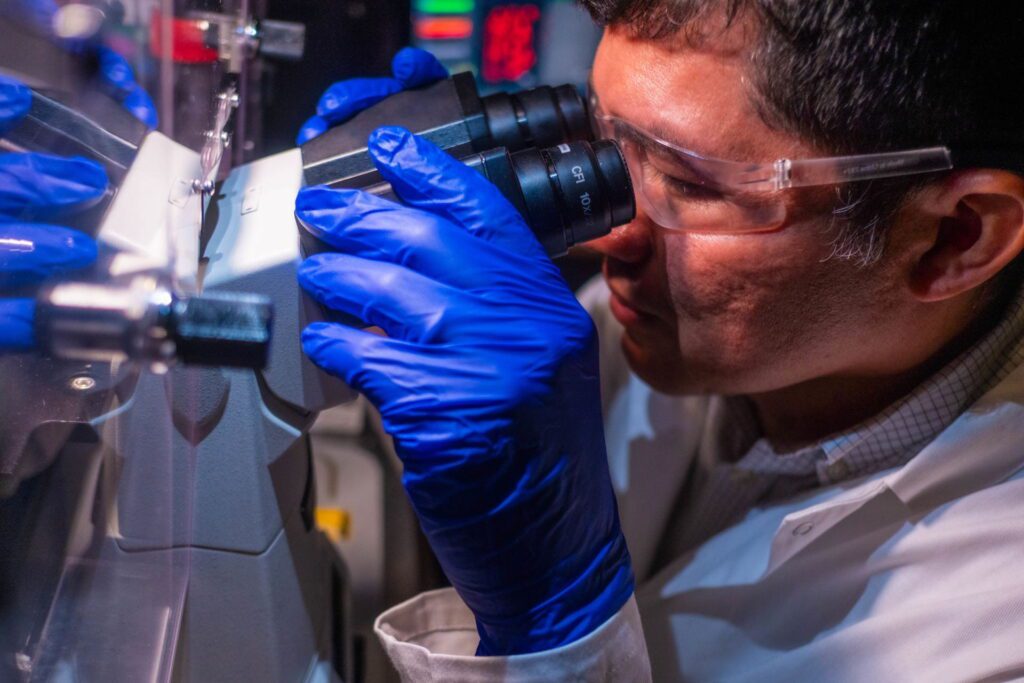
Cover image: Ciceron Ayala-Orozco is a research scientist in the Tour lab at Rice University, and lead author on the study. (Photo by Jeff Fitlow/Rice University)
by: Mia Lee
published on TrendyDigests