

A revolutionary new cancer treatment slows the growth of tumors.
It attacks them by tricking cancer cells into absorbing a snippet of RNA – a molecule present in the majority of living organisms and viruses – that naturally blocks cell division.
Malignant tumors treated with the new therapy did not increase in size over the course of a 21-day study, while untreated tumors tripled in size over the same time period.
Scientists explained that cancer can begin almost anywhere in the human body.
It is characterized by cells that divide uncontrollably and that may be able to ignore signals to die or stop dividing and even evade the immune system.
Study lead author Dr. Andrea Kasinski says the new therapy, tested in mice, combines a delivery system that targets cancer cells with a specially modified version of microRNA-34a, a molecule that acts “like the brakes on a car,” slowing or stopping cell division.
As well as slowing or even reversing tumor growth, the targeted microRNA-34a “strongly suppressed” the activity of at least three genes – MET, CD44 and AXL – known to drive cancer and resistance to other cancer therapies, for at least 120 hours.
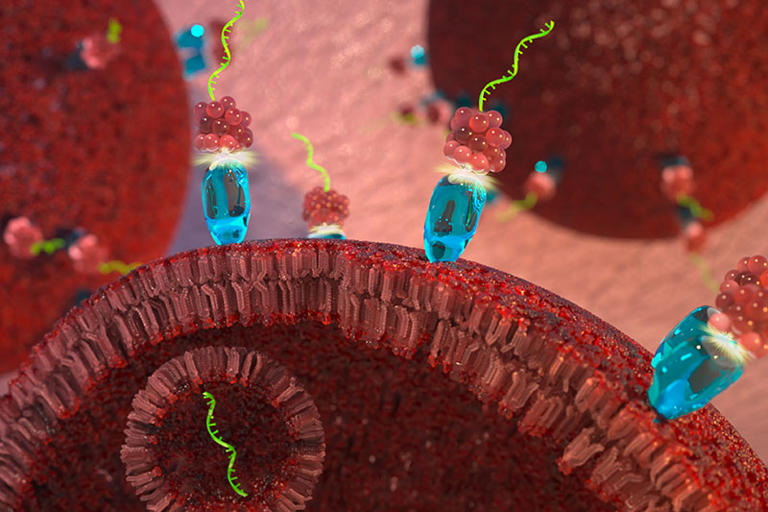
A new therapy targets cancer cells with a modified strand of micro-RNA that naturally blocks cell division. (Second Bay Studios / Purdue University via SWNS)
The results, published in the journal Oncogene, indicate that the patent-pending therapy, the newest development in more than 15 years of work targeting microRNA to destroy cancer, could be effective on its own as well as in combination with existing drugs when used against cancers that have built drug resistance.
Dr. Kasinski, of Purdue University, said: “When we acquired the data, I was ecstatic.
“I am confident that this approach is better than the current standard of treatment and that there are patients who will benefit from this.”
In healthy cells, microRNA-34a is abundant, but its presence is dramatically reduced in many cancer cells.
While the idea of reintroducing microRNA-34a to cancer cells appears simple, the research team has had to overcome several challenges in crafting an effective therapy.
Experiments on mice show their modified microRNA-34a endures for at least 120 hours after being introduced.
Dr. Kasinski says the fully modified microRNA-34a is “invisible” to the immune system, which would normally attack double-stranded RNA introduced to the body.
She added: “The targeted specificity of the therapy reduces the amount of the compound that must be administered to be effective, which in turn reduces potential toxicity, side effects and cost.”
Dr. Kasinski said her team can also prepare a separate version, which targets a different cell surface receptor, for prostate cancer cells.
They are now preparing for clinical trials.
Story by Talker News
published on talker